We wander in and wonder at the beauty of our "Land Down Under".

Tuesday, 8 April 2014

Wet Weather Blogging!

Wednesday 9th April


It’s wet here in the Wimmera. Although we don’t get exact data from the Bureau of Meteorology for Natimuk, 13 millimetres of rain fell in Horsham yesterday. It hasn’t yet rained this morning but the Bureau is is calling for “rain at times”, and my Weatherzone Plus app says it is 90% likely - with between 10 and 20 mm of wetness supposed to drop from the sky. 

Don't you just love technology?
An aside before going further. In an earlier post I forgot earlier to include a photo from when we did our bike ride in Moruya. On the way to Congo we noted a whimsy of locals: nailing teddy bears to trees. Here’s an example:


Crimes Against Teddy Bears
We don’t plan to climb today. And we may be looking for alternatives the next few days as well if the BOM has their modelling right:


Not to worry. There's plenty of time left to get on those climbs we want to do before leaving. One of the good things about being retired and on the road is that you don’t have to fit in your fun around work and “Home Duties”. If something - like the weather - gets in the way of immediate plans, you just wait a while. 

Something that we find so remarkable about being in this part of the country is the way grass sprouts so quickly when rain comes, and the way the some of the eucalypts burst so suddenly into flower. It can be quite a transformation over just a few days.

And, as if by magic, the bird life changes accordingly. Already there are more rosellas around camp than when we arrived five days ago. Di is sure the lorikeets will also arrive in numbers over the next few days, when those eucalypts come out in flower. Going by past experience she’s probably right. Incidentally, as I sit composing this, the Long-billed Corellas are swarming around the camp with their charming sociability, and the rain has just started to fall again. Maybe that is what is making the corellas so talkative.

The other day Di took a stroll down by the lake and took a few photos. Here’s one of the corollas:


Not the best photo, but I wanted to show the long, curved beak.

And here is a pair hanging out amongst their mates ...


The last time we were here there were plenty of Black Swans swimming in the lake. They’re still here but now their standing their ground ...


That photo makes it look like there's still quite a lot of water in the lake. The panorama that Di took testifies otherwise ...


That panorama covers quite a distance and when I looked closer I could see some folks out on the lake bed, a photo in a photo so to speak ...


For those of you who are interested, that's Mount Arapiles in the background. Di took these photos the day before yesterday and we haven't seen "The Mount" since.

Unfortunately the rain is unlikely to be enough to restore the lake level to what it was in 2011-12, when there were people wind-surfing, water-skiing, fishing and even sailing. It probably needs to get back up over the 2 metre level mark on this gauge for that to happen ...


This old behemoth of a tree stump ... 


...was mostly submerged when we were here after the big wet in 2011. A year later it was still in the water but by autumn of last year it was just at the water's edge. Now the water is probably 100 metres away. What's that white stuff draped over the right end? Well, it's actually wool, and strewn across this part of the dry lake bottom there are large patches of wool laid down perhaps 10 - 20 mm thick. This is the lee shore of the lake and it appears that the wool has been blown here across the lake and collected. Yes, there are a lot of sheep around this area, although the Wimmera is mostly known for the growing of wheat.

On previous trips we haven't noticed Royal Spoonbills here before, but there are plenty of them scouring the lake as well. So far Di hasn’t managed to get a close enough photo to include; hopefully we’ll be able to post one before we leave here. We also hope to make some photos of Freckled Ducks, which are currently populating the lake. Phil at the Arapiles Mountain Shop tells us that the lake is closed to shooting because of the presence of those ducks, which are protected due to their endangered state. Although it's a worry that the Freckled Duck is endangered, we are very pleased that there is no shooting here this year. We found it quite confronting last year, especially with the number of guns that were still going off when it was almost pitch dark.

In camp itself, along with the Long-billed Corellas there are Willy Wagtails, Superb Wrens and Crested Pigeons in abundance.

Here's a photo of a Crested Pigeon (not one of the best due to low light levels, but taken just beside the camper):

Crested Pigeon
Just after I started typing this, Di came back from visiting Justin, Stu, Bob and John - friends from Hobart - who are staying in one of the cabins here at the lake. They have a limited time so they thought they’d head over to The Mount to see if they could get a climb in. Sure enough, as if just on schedule, the rain started to fall almost immediately after they left. And it’s still falling. Which reminds me. We are very fortunate with the quality and quanitity of information produced by our national Bureau of Meteorology. Recently Evan, our son-in-law in Cairns, alerted me to their latest annual report on the state of Australia’s climate. Pretty technical, but some of the graphs are very interesting. Highly recommended.

Speaking of climate reporting, I was gobsmacked to read in the Mercury online yesterday an opinion piece bagging our current government’s head-in-the-sand stance on climate change. It wasn’t so much the facts themselves - everyone who pays much attention knows that Abbott and co don’t want to know - but the fact that The Mercury would print such a piece at all, let alone so prominently. Our little Hobart paper hasn’t been know to expose the weaknesses of Australia’s right when it comes to issues of social justice and environment in particular. I wonder if there is a new editorial policy in place.

It’s about time for me to wrap this up. We’ll head out for a walk in the rain and see what the birds are doing, then come back and have some lunch. It would be fun to potter around on the bikes too, but that isn’t going to happen today. The reason: I didn’t think to cover the saddle of my bike with a plastic bag before the rain started falling yesterday morning and we headed off to town.

A little while later ...

We had our walk. The lads returned from The Mount without getting in a climb and decided to use their time in some rescue review ...


It's after lunch now and Di is having her "Nana Nap". I'm dreaming of climbing other places - like Red Rocks in Nevada. We did a great route there in 2005 called Dream of Wild Turkeys (via a 2 pitch variant called Yellow Brick Road) on the Black Velvet Wall. Di took this photo of me about 2/3rds of the way up...


What brings this fabulous place to mind is that our friends HJ and Tammy were just there, and did another wonderful route called Crimson Chrysalis on Tammy's 44th birthday. (What a great way to celebrate a birthday, eh!) It's said that it "could quite easily be the best 5.8 in all of Red Rocks". HJ sent a few photos,  including this beauty ...


That's about it for this post. Hopefully we'll have done some climbing locally rather than just in our imaginations the next time ....

Saturday, 5 April 2014

Small Town Memorials

Does the title of this post ring a faint bell for you? In trying to come up with something to get me started, I realised that the major theme of the past three days has been small towns. Passing through, stopping here and there. We deliberately took a longer route to get to our destination, partly to get off the main roads, partly to see some places we hadn't been through before. So, we passed through lots of small towns.

Getting back to the title, when I first met Di she had a slim volume of poetry on her bookshelf by Geoff Page.  Here is the eponymous poem of that memorable little book, published in 1975:

Smalltown Memorials

No matter how small
Every town has one;
A few names inlaid;
More often full-scale granite,
Marble digger (arms reversed),
Long descending lists of dead:
Sometimes not even a town,
A thickening of houses
Or a few unlikely trees
Glimpsed on a back road
Will have one.

1919, 1920;
All over the country;
Maybe a band, slow march;
Mayors, shire councils;
Relatives for whom
Print was already
Only print; mates,
Come back, moving
Into unexpected days;
A ring of Fords and sulkies;
The toned-down bit
Of Billy Hughes from an
Ex-recruiting sergeant.
Unveiled;
Then seen each day -
Noticed once a year;
And then not always,
Everywhere.

The next bequeathed us
Parks and pools

But something in that first
Demanded stone.

I guess the poem stuck with me. There are some gems in that little volume and I recommend hitting the link to it I've inserted above.

After spending a couple of days poking around the Moruya/Batemans Bay area while we had a bit of work done on our camper trailer we set off a bit later in the afternoon than we'd anticipated. We were pretty keen to get up and over the main range before the forecast heavy rain hit, so we didn't waste any time once we were on the road. There was a bit of road works happening on the steep slopes of Clyde Mountain that held us up briefly ...

,

... but no problems with bad weather conditions. 

Once up this obstacle the first place of interest is the old town of Braidwood, which has preserved much of its historical architecture. This might have been what helped us decide to eschew the motorway once we reached the plateau, and head further inland instead. It was a bit of a punt, but luck seemed to be with us. Traffic was light and we motored along for a couple more hours before passing through Harden and on to the adjoining hamlet of Murrumburrah where we discovered free camping in a park just off the main road. Brilliant luck, as we got the canvas up just before a big thunderstorm hit.
Here's what the day's journey looks like on Google Maps:


Lightning flashed off and on through the night and it rained enough to leave quite a few large puddles all around us. We finally packed up the next morning at about 10:30 when the rain eased to a steady drizzle. It was fun passing through towns like Cootamundra, famous as the birthplace of the great Don Bradman.

A little more than an hour later we found ourselves in Junee, a well-preserved historic railway town. It was so attractive we decided to stop and have a look around. Here's a beautiful hotel built in 1896 :


There is a lovely little square in front of the old railway station (which is still in use), probably built so that folks had plenty of room to manoeuvre their horses and buggies. Here's a panorama of the railway station that doesn't really do it justice ...

There was even a train stopped at the station ...


Junee was built as a railway town to serve the surrounding farming district, and the station houses a huge café still operating today ...


It was really a bit early for lunch but we decided it would be good to enjoy the atmosphere of this old café so we stayed for a bite before pushing on.

A few more hours of driving took us through towns with names like Coolamon, Lockhart (another pretty little town), Jerilderie, Finley, Tocumwal and Numurkah. The latter wasn't really en route, but Di wanted to divert via there as it was where her paternal grandmother lived before moving to Tasmania. Sure enough, the first thing we saw as we entered town was the Numurkah war memorial ...


We looked closely but there was no-one by the name of Lapthorne (Di's grannie was Florence Lapthorne) represented on the memorial. After years of driving too far for too long when we're on  the road, we've finally decided that we will take a good break every couple of hours and walk around a bit when we're doing long drives, so we took a stroll around Numurkah. Sadly, it wasn't one of the more attractive towns on our journey. About the only building that we found which had retained a sense of grace was the old courthouse ...


By this time we had left the rain behind. We'd picked a spot the night before that we thought would make a good overnight stop, but because of our late start we had our eyes peeled for something a bit less far down the road. We spotted a lovely little park in Echuca, but overnight camping was not allowed. We decided to push on a little more briskly to Tarrick Tarrick National Park to allow us time to find something else in case that didn't work out. (The slight worry was that it is a dry-weather-only road, and, according to our parks guide, suitable only for "small vehicles" - whatever that means. It turned out to be perfect. We arrived well before dusk. No problem getting in and we had the place all to ourselves, after about seven hours of driving (I admit that we were travelling a little faster than recommended for some of the time ) ...


This morning we spent a couple of hours wandering about enjoying the park before we left at about 10:15. The park features a beautiful forest of Callitris Pines and a couple of gently-rounded granite domes. There were wallabies around camp and bigger kangaroos bounding about as we drove in and out of the park. Di even saw some galahs to photograph, so you get cockatoos ...


... and a kangaroo (two if you look closely) ... 


in this post!

In the previous photo you can see evidence of the granite slabs and domes I mentioned. Here's an image of the top of Mount Terrick Terrick ...


Nestled in shady and sheltered spots were lots of gorgeous little orchids. Here's an example ...


Back out to the highway at Mitiamo, turn west for 25 kms, then north on the Loddon Valley Highway for 10 kms to Durham Ox. West on the C267 for 21 kms to Boort, then southeast on the C266 to Charlton, and another delightful surprise. This town was badly affected by flooding in 2011 but must have a brilliant sense of community spirit. There was wide speculation that the town might never recover but what you will see if you ever visit is a vibrant little community that seems stronger than ever. As we entered town we noticed a sign that said "Travellers' Rest", and parking for large vehicles. We thought we might stop and look around, so we pulled into a shady flat spot. It turns out that this travellers' rest area has been built in the area where the old Charlton Sale Yards were ...


They've got a great little park straddling the Avoca River complete with a pedestrian swing bridge. The first thing that really caught our eye was this four metre long sculpture ..


It turns out that it was from the 2006 Commonwealth Games in Melbourne, and celebrated the participation of Kenya (apparently swordfish abound off the coast of Kenya).

The town has provided a great little area for passers-through to stop and have lunch in the shade ...


... a free camping area complete with a campers' garden ...


After doing a loop through the park, across the river and back along the main road our attention was caught by this neat little car on the footpath ...


It was sitting outside a shop called "Gallery 79". We got talking to the guy who ran it. The shop had been totally ruined in that big flood of 2011, just a year after he'd moved in. You'd never know it now. Here's what it looks like today ...


Unfortunately, I didn't get any photos inside: we were too busy talking with the fellow who runs it. His name is Geoff Coote, and he's a pretty neat guy. His current passion is steampunk, and he's made some amazing creations. In case you don't know what steampunk is and don't have the time to find out right now, here's a brief summary: Steampunk is modern technology—iPads, computers, robotics, air travel—powered by steam and set in the 1800’s.
If you'd like to find out more, here's a link. We did spend a bit of money in the shop: a little something for someone special, can't say more here because we don't want to give the game away now, do we?
If you ever find yourself passing through this corner of Oz make sure you allow yourself a little time to meet Geoff and savour the delights of his creativity.

After our hour in Charlton it was really time to get to where we were headed. We stopped briefly in Horsham to get some groceries, then at the Arapiles Mountain Shop to pick up Di's climbing shoes that she had sent in for resoling and then off to Natimuk Lake. So, here's what today's few hours of driving looks like on the map ...


And here's where we're at for the next three weeks in case you'd like to drop by ...


And now it's time for bed
~
there's climbing to be done in the morning!


Tuesday, 1 April 2014

Getting off the highway

Monday, Monday

A painless exit from the ferry, set the GPS for Sale and we are away! There's not a lot to tell about getting out of Melbourne except that it's worth it having an Eastlink account, which allows you to use the motorways without incurring a fine afterwards!

One good thing about the ferry arriving early in the morning is that exiting the city is usually pretty painless if you've got your directions sorted. All the traffic is going into the city and you're on the way out. Works for me.

Having set ourselves the goal of visiting some lesser-known and out-of-the-way parks in our travels, we'd decided to head for the the northeast corner of Croajingolong National Park, near Mallacoota. It's a bit over 500 kilometres from Port Melbourne where the Spirit of Tasmania docks to Mallacoota. We thought that was pretty doable given our early start off the ferry, allowing for time to get out and stretch our legs every few hours. The drive was pretty uneventful except for one thing: shortly before arriving in Mallacoota we spotted our first ever Superb Lyrebird just beside the highway. It was to prove to be just the first of many beautiful birds we have seen over the past two days. Unfortunately it didn't hang around long enough to get a photo but you might like this video:


After numerous stops and an ice cream in Mallacoota, it was late afternoon before we finally reached Shipwreck Creek, our stop for the night. This little campground, which has only five campsites, was predictably deserted when we arrived so we had our choice of spots. Currawongs and kookaburras were squabbling amongst themselves in the neighbouring site, as whoever had been there previously had left a bit of rubbish in situ.

Up went the canvas and then we had a stroll down to the beach to work out the kinks. We probably should have had a swim but were put off by the warning signs about rips, shallow sand bars and hidden rocks - which we realised later seem to be in place along all the non-supervised beaches in national parks in this part of the world. It was nice just to be able to have a beach all to ourselves, in contrast to the main beach in Mallacoota which has a massive caravan park crowding it. 

Tuesday

The main reason for covering 500 plus kilometres out of Melbourne was so that we could spend the morning exploring the environs of Shipwreck Creek. It was so nice being back in the camper again though, we slept in quite late and read our books for a while before getting out of bed and having breakfast.

Eventually, we wandered along a track to the headland behind camp. We were rewarded with sightings of Scarlet Rosellas, Eastern Yellow Robins, Superb Fairy Wrens, and Red Wattlebirds. There were also little thornbills and other tiny birds delighting us by darting in and out of the coastal scrub which we weren't able to identify.

Down to the beach we went, where Di got this photo of me enjoying the solitude ...


It seems there is always something worth seeing if you take the time to look. Here's an example ...


There's an extensive coastal track that we decided to wander along to see what we else we could see. There must have been a bit of rain recently in this part of the world because we saw quite a few mushrooms sprouting amongst the grass and leaf litter alongside the track ...


We not very good on our insects. Can anyone identify this butterfly for us?


The environment is clearly well adapted to fire. The following photo doesn't really represent very well the strong impression of resilience these old, gnarly, banksias - trunks blackened but covered in healthy green foliage - projected on to us ...


What tough plants these must be! I think they are amazing, defiantly withstanding the worst that nature can throw at them. And they are just one of about 170 different species of this fantastic genus in the Australian landscape.

A little before noon we decided it was about time to continue our journey northward. Into Mallacoota we went to top up our supplies and have a stroll around the township. Di is always finding ways to corrupt me, and today was no exception. Despite having bought some groceries for lunch, when we wandered past Lucy's Noodle Bar and Di sniffed the great aromas wafting out of the kitchen, that was that. It turned out to be a pretty good deal though: a fantastic bowl of noodles with veggies and meat, nicely garnished with peanuts and herbs for eight dollars. Yum! Here's Di tucking in:


A couple of years ago when we were up here on the south coast of New South Wales we stayed on the beach at Potato Point along with a bunch of other folks. And, while out riding our mountain bikes we'd spotted a quiet little nook that we thought we could tuck into all on our own on a future visit.

The forest hereabouts is fantastic. Great, smooth-trunked trees shooting skyward. And on the forest floor there are lots of fantastic ferns. A few of them were fruiting ...


We are now ensconced in our little free campsite, tucked under the trees ...


...  where wallabies wander tamely ...


Di is playing me tunes on her tin whistle as I finish this off. It's been another great day on the road ...

Early morning update: Email feedback has come in from a number of you and, thanks to our friend Steve Bunton I can add some detail. The butterfly is commonly known as the "Swordgrass Brown". As we are pretty common, that will do for us. However, for those of you who like to go all Latin, it is a member of the family Nymphalidae and has the name Tisiphone aboena. The fruiting fern is actually a cycad (I should have known that) and is Macrozamia communis. Aborigines called them Burrawangs. The fruits can be eaten but need to be soaked in water first to remove the toxic alkaloids. Bunty also says that you shouldn't buy a house with a Burrawang in the yard because they have huge tuberous routes that play havoc with the foundations! Finally, according to Bunty who is a caver and spends a lot of time near Hastings Caves in southern Tasmania, lyrebirds are abundant in that area, where they were introduced as an insurance population due to all the land clearing for dairy farming on the south coast of NSW. Thanks Bunty!

Saturday, 29 March 2014

On the road again

It's late March and we're about to board the ferry from Devonport to Melbourne for a couple of months on the mainland. A short tour up the eastern seaboard to the south coast of NSW and then across to western Victoria and South Australia for a bit of climbing and general bumming about.

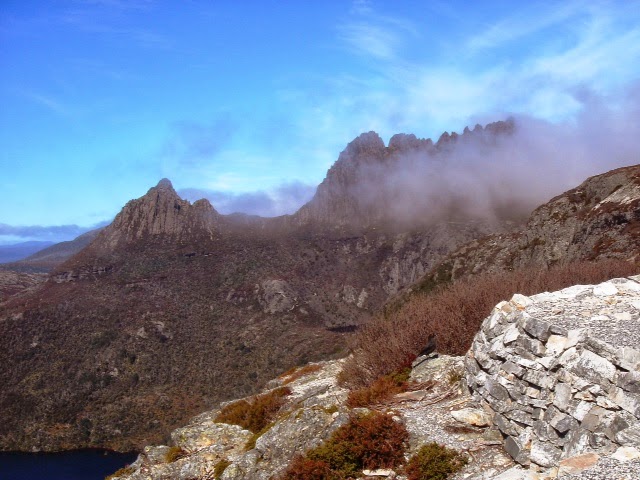
We've just had a couple of days at Cradle Mountain to help commemorate the 100th anniversary of the first roped climb in Tasmania - and possibly Australia, although there is some contention about this from certain quarters on the big island to the north. This climb consisted of a traverse of the skyline of Cradle Mountain by the Malcher brothers in April, 1904. Just getting to Cradle in those days was quite a saga, but these guys carried massive packs with assorted stone age climbing gear including a 60 centimetre long water level to determine relative heights of nearby peaks. Here's a picture of the skyline of Cradle I took from Marion's Lookout in September when we were just heading off on the Overland Track:


It's a pretty alluring route, don't you think? 

Tony McKenny of the Climbers Club of Tasmania thought that the traverse ought be marked in some way or other. The plan for the weekend was to get as many climbers together as possible and, weather permitting, duplicate the Malcher brothers' traverse - albeit with modern gear, have a slide show featuring some climbing in wilderness Tasmania down through the ages and tell some tall stories.

A spanner was put in the works by Huey with the weather. It was warm enough, but persistent drizzle morphing at times into light rain kept most of us off the skyline. In the end only six intrepid souls embarked on the traverse, carefully picking their way along the route. The black moss that covers the rock on Cradle is notorious when wet but all returned safe and sound, although at least two of them shredded the backsides of their wet weather trousers while getting as much friction on the rock as they could!

The rest of us - and there were about 40 people engaged in this get-together - enjoyed the network of trails that thread are found around the peak. Di and I headed off early because we wanted to do a longish hike around the mountain. Here is a map showing the route we took:


We had a pause and a snack at the Scott-Kilvert Memorial Hut at Lake Rodway, where four Germans and a Finn had spent the night. They had all come to Tasmania for the hiking and were enjoying themselves immensely despite the weather.

I hadn't got the camera out for the first three hours because there just weren't any views, but shortly after we left the hut we passed by a great little spider's web hanging beside the track and I just had to take a photo ...


... and while I was at it I thought I might as well take a happy snap of Di ...


A little further along the track we spotted a small orange mushroom - about the size of the nail on your little toe - in the middle of the track ...


My little camera doesn't really have a good enough light sensor to reproduce the colour, which was a much richer, darker orange.

Although it was drizzling and raining most of the time we were walking, the stillness did allow for some great reflections at the much-photographed Artist's Pool up on the little plateau between Little Horn and Hanson's Peak ...


A hop skip and jump up over Hanson's Peak, down to Lake Dove and past Lake Lilla got us back to Ronney's Creek in time for a late lunch.

We all reconvened at the Cradle Mountain Visitors Centre for a very entertaining slide show, then had a meal at the pub. It was great to catch up with old friends and meet some new ones. And now I better finish as it's just about time for me to pack up this computer and drive down to Devonport (we're currently sitting in a car park in Latrobe) to get in the queue for the ferry. I'll post again in a week or so when we have more news of our travels. In the meantime, I'll leave you with this photo of our travelling roadshow ...


Di's sitting in the front, playing her whistle. She's been reading and dozing in the sun while I hurriedly scrambled together this post. So, time to go. Catchya later ...